Are All My Decisions God’s Will or My Selfish Needs?
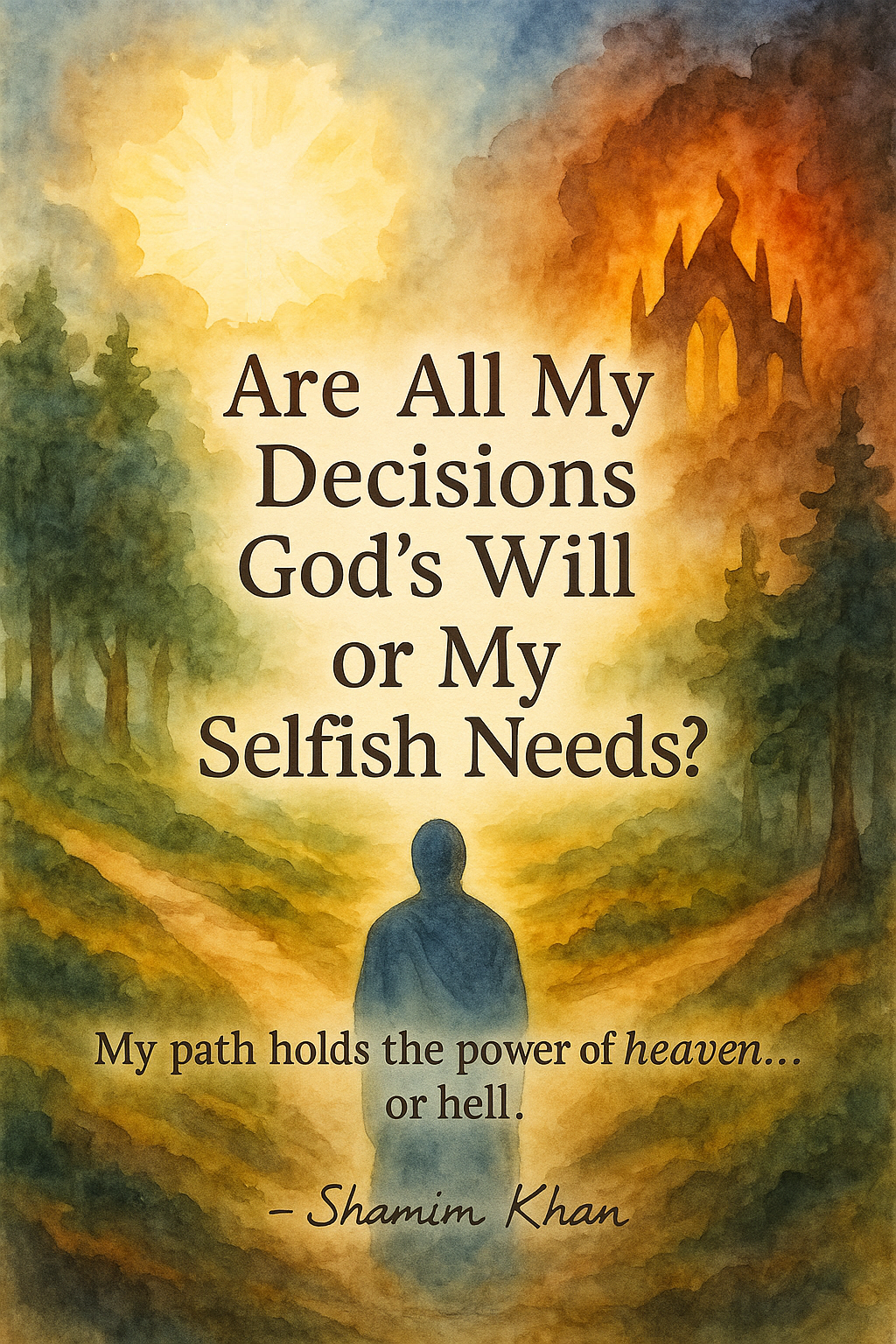
Every choice we make is a quiet conversation between who we are… and who we hope to become.
There are moments in life when a single question cracks open the quiet interior of the soul.
A question whispered in movies, books, sermons, or by the private voice we try to ignore:
“Are all my decisions God’s will… or my selfish needs?”
It’s a deceptively simple question — yet when you sit with it, it becomes something vast, almost cosmic.
It forces you to consider the invisible threads guiding your choices, the silent battles inside your heart, and the possibility that every decision is a step toward heaven or away from it.
But what if the truth is far more nuanced, far more human, and far more hopeful?
The Two Voices Within Us
Most people imagine the world in dualities: right or wrong, divine or selfish, heaven or hell.
But inside each of us, the landscape is much more textured.
We are a blend of:
The higher self — the part that seeks goodness, meaning, compassion, connection.
The survival self — the part that seeks comfort, safety, validation, or control.
Both voices are human.
Both voices are real.
And both shape our decisions.
When we ask, “Is this God’s will or my selfish need?”
what we’re really asking is:
“Which part of me is leading this moment — the fearful self or the loving self?”
Because in nearly every spiritual tradition, love is the closest thing we have to the divine.
God’s Will Isn’t Always a Thunderbolt
Sometimes we imagine God’s will as a dramatic sign — a door opening, a lightning flash of clarity, a moment of unmistakable guidance.
But more often, it’s subtle.
It feels like:
A quiet intuition nudging you gently
A feeling of peace that appears when you choose compassion
A sense of alignment, like you are being carried rather than pushed
A whisper in the conscience that says, “You can do better than this.”
God’s will doesn’t force — it invites.
It’s not a command shouted from the clouds.
It’s the soft shift inside your chest when you move toward what is true.
The Role of Selfishness — and Why It’s Not All Bad
We tend to demonize “selfish needs,” as though everything we desire is spiritually dangerous.
But consider this:
The need to rest is not selfish.
The desire for joy is not selfish.
Wanting to be loved is not selfish.
Wanting to grow, to heal, to be safe — none of these are selfish.
Sometimes what looks like “selfishness” is actually a bruised part of your soul trying its best to protect you.
The mistake is not desire itself —
the mistake is letting desire blind you to consequences.
A selfish choice is only harmful when it:
Hurts another person
Harms yourself
Pulls you away from who you want to become
But desire, in its pure form, is not the enemy.
It is the compass that tells you what matters to you.
And sometimes, what matters most is exactly what God has been trying to show you.
The Moral Compass: Heaven and Hell as Directions, Not Destinations
The question hinted at something profound:
Do my choices pull me toward heaven or toward hell?
But what if heaven and hell are not distant realms after death —
but states of the heart we experience here, one decision at a time?
Every choice made in truth, compassion, courage, and humility
moves us a little closer to heaven —
a life of meaning, connection, and inner peace.
Every choice made in fear, envy, deceit, or reckless desire
moves us toward a kind of inner hell —
a life of regret, fragmentation, and emotional chaos.
In that sense:
God’s will is simply the path that keeps you whole.
Selfishness is the path that divides you from yourself.
So How Do We Know Which Is Which?
Here is a simple test — gentle, honest, grounded:
Ask yourself these three questions:
Does this choice expand me or shrink me?
Growth feels divine. Fear feels restrictive.Does this choice harm or heal?
Love is always closer to the truth.Does this choice bring long-term peace or short-term relief?
The soul knows the difference.
If your decision aligns with expansion, healing, and peace —
you are likely walking in the direction of God’s will.
If it aligns with escape, ego, or impulse —
you may be acting from the wounded self, not the whole self.
The Beautiful Middle Ground
Here’s a comforting truth:
Most of our decisions are a mix — part divine, part human.
We learn, we stumble, we course-correct.
We listen to the ego, and then we hear the whisper beneath it.
We want things for ourselves, and sometimes those very wants lead us to spiritual awakening.
Life isn’t a tightrope between God and selfishness —
it’s a dance between guidance and choice.
God doesn’t micromanage your decisions.
He accompanies you through them.